
In Toeing Treatment in Kids Toowoomba & Warwick
Put your children's best foot forward with our optimised care.
What is In-Toeing / Pigeon Toes in Kids?
In toeing is what is commonly known as being pigeon-toed, and it is a fairly common condition in children. You don’t see many adults who in toe, because children often grow out of it, but it can be worrying for parents.
At Optimise Health this is one of many conditions for which we provide care – and, crucially, advice. In-toeing treatment for kids is something we have great experience with. Treatment of in toeing depends on the cause, and there are several possibilities.
Causes of In-Toeing
One possible cause is metatarsus adductus, which is when the forefoot is twisted inwards. To help understand this, let’s look briefly at the anatomy of feet. The toes are the end or front parts, but before we reach them, there are the metatarsals, which run all the way from the midfoot at the top of the arch, and the midfoot in turn connects with the hindfoot, the rear part which includes the ankle and heel.
With all these conjunctions of bone there must be connective tissue to join them and keep us comfortable and moving. The tissue allows a certain amount of sideways movement, and the foot can be bent in this way in the womb, so that a newborn may emerge with metatarsus adductus and it may take a while to correct itself.
Another possible cause of in-toeing is internal tibial torsion. The tibia is one of the bones between the knee and the ankle. Torsion means twisting, and when something gets twisted it becomes shorter. Because these bones are part of a chain going all the way to the toes, this becomes marginally shorter and pulls the forefoot to the side because it doesn’t have the ‘slack’ to allow it to sit straight. Internal tibial torsioning tends to happen between the ages of 1 and 2.
A third possible cause is excessive femoral anteversion. Femoral means something to do with the femur, a bone in the thigh, and anteversion means tilting forward. If the femur is tilting forward ‘excessively’ it is going to alter the shape further down the chain, and the end result is what we see as in-toeing.


Signs & Symptoms of In Toeing.
The obvious sign of in-toeing is that one foot or both feet are turned inwards and there is a noticeable difference from the standard way of walking and running. As for symptoms, there may be no discomfort, but a child may trip and fall over more than expected.
Another sign could be uneven wear on shoes, which can be easy to miss if you’re not looking for it.

Treatment for In-Toeing.
At Optimise Health we specialise in three areas:
Podiatry looks at the feet, while physiotherapy takes care of the whole body’s muscles and joints. Pilates is the gentle but firm exercising of muscles and joints to improve agility and suppleness.
With this trinity of disciplines, we treat the whole person, not just the specific symptoms, because as we have already seen above, the toes, for instance, can be affected by bodily conditions a long distance away.
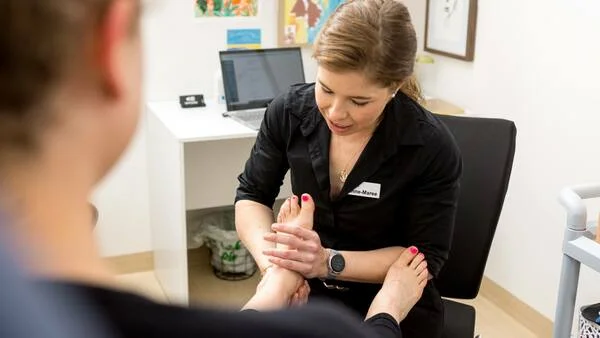
With a new patient we will carry out a biomechanical assessment so that, while we aim to resolve whatever the issue may be, we look at the broader picture so that we can get the whole body contributing to the welfare of a struggling part. With in-toeing, for instance, we will assess which of the potential causes is the culprit in this case and treat the patient accordingly.
Sometimes in-toeing resolves itself in time, and if so, that’s great. Once we know what is causing it, we can often put the family’s minds at rest. We can also recommend physical activities which can be beneficial and advise on others.
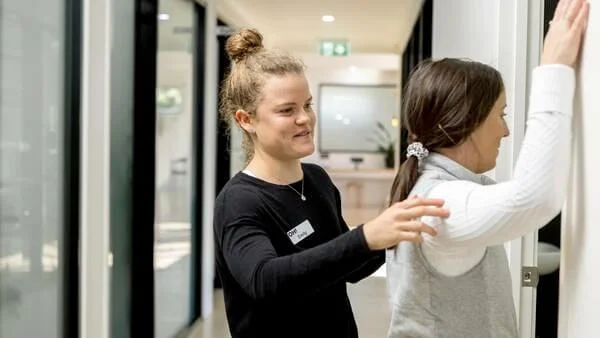
Depending on the cause we may suggest swimming or even ballet or horse-riding. We will look at the child’s posture including how they sit and make recommendations which parents should encourage and supervise. That includes things to do and things to not do – all part of normal parenting, but with specific aims because they have a specific issue to address.
In most cases special shoes are not necessary and not beneficial anyway, although quality footwear is always a good thing and can have a significant effect on the child’s more general development.
How Optimise Health Can Help You?
The Optimise Health way is to work with the body, doing our part to help bring about a resolution that is natural and logical. Surgery is not needed in the vast majority of cases.
Two Great Locations.
Optimise Health have multiple specialists working across our two conveniently located clinics in Toowoomba and Warwick.
14 Ipswich Street, Toowoomba
Monday 9:00 am – 6:00 pm
Tuesday 7:00 am – 5:00 pm
Wednesday 9:00 am – 6:00 pm
Thursday 8:00 am – 5:00 pm
Friday 7:00 am – 4:00 pm
Saturday Closed
Sunday Closed
Shop 2/44-46 Wood St, Warwick
Monday 8:00 am – 4:00 pm
Tuesday 8:00 am – 4:00 pm
Wednesday 8:00 am – 4:00 pm
Thursday 8:00 am – 4:00 pm
Friday 7:00 am – 3:00 pm
Saturday Closed
Sunday Closed
Why Choose Optimise Health's Paediatric Podiatrist?
We have been working in the podiatry field for more than 20 years and have added the physiotherapy and Pilates aspects because they complete the work we do with feet. We provide world-class integrated allied health care in Toowoomba, Warwick, and the Darling Downs. We have a large team with great experience and expertise in different aspects, including a paediatric podiatrist – and because they are all under one roof, one can help another as we work on the best result for the patient.
Whereas in most medical situations you might have to wait to be referred to someone with a different speciality, with us that can be done the same day in the same building.
On the technological side we have state-of-the-art equipment to help with both diagnosis and treatment. In addition to these benefits, we have a large car park and excellent wheelchair access, because we believe the whole experience with us should be top notch, from the reception and treatment you receive to departure in better condition than you were when you arrived.
You will see our name around town, particularly at running events and so forth, because we like to engage with the community and extend our influence. Nothing gives us more pleasure than seeing our patients thriving and moving smoothly, enjoying life.
In-toeing treatment for kids is something we can definitely help with. The condition can be unsettling for the child and the family, but help is at hand and in all probability it will soon be resolved for you.

Multi-Disciplinary Approach

State-Of-The-Art Facilities
